Home Blog Page 16

AHRC Condemns Tragic Church Shooting in Grand Blanc, Michigan

AHRC Condemns Tragic Church Shooting in Grand Blanc, Michigan

The American Human Rights Council (AHRC-USA) strongly condemns the recent mass shooting that targeted the Church of Jesus Christ of Latter-day Saints in Grand Blanc, Michigan. This senseless act of violence, committed on Sunday, September 28, 2025, claimed the lives of four innocent individuals and left eight others wounded. The alleged shooter, Thomas Jacob Sanford—a former U.S. Marine and Iraq War veteran—was killed during the incident.

This horrific crime is yet another painful reminder of the persistent threat of violence in our society. Tragically, it is not the first such attack, and without meaningful action, it may not be the last. Regardless of motive, such acts demand a unified response from all sectors of society—local, state, and federal governments, civil society, and everyday citizens—to foster collaboration and sustain active engagement in the pursuit of public safety.

Crimes of this nature are crimes against all of us. They defy justification and must be met with unwavering condemnation. Our collective safety depends on our shared commitment to stand united against hate, extremism, and violence in all its forms—political or otherwise.

This tragedy also underscores the urgent need to confront the reality of violence as a deep and ongoing challenge facing our nation. No one should ever experience such terror, especially in places of worship—spaces meant for peace, reflection, and community.

AHRC urges all houses of worship to take the threat of violence seriously. While the risk is small, the threat is real. We recommend that houses of worship reach out to law enforcement if they need basic training on dealing with threats.

The American Human Rights Council extends its heartfelt condolences to the families and loved ones of the victims of this brutal attack. We also wish a full and speedy recovery to all those injured.

AHRC remains steadfast in its commitment to promoting peace, justice, and the protection of human rights for all regardless of race, faith, and origin.

Standard Chartered: 20% of Corporates Globally Eye UAE for Future Supply Chains

Standard Chartered: 20% of Corporates Globally Eye UAE for Future Supply Chains

Standard Chartered announced today the findings of its latest ‘Future of Trade: Resilience’ report, which identifies the United Arab Emirates (UAE) as one of six stand-out markets shaping the future of global trade. The report highlights that 20 per cent of corporates globally are reviewing their supply chains through the UAE, underscoring its position as a resilient commercial hub with strong international connectivity.

The study, which covers 1,200 corporates with annual revenues above USD 250 million across 17 markets, also reveals that companies are increasingly looking to the UAE to access opportunities with Mainland China, ASEAN, Africa and the United States, reflecting its growing role as a connector across some of the world’s most dynamic growth corridors.

Commenting on the findings, Mohammed Salama, Regional Head of Client Coverage for Corporate and Investment Banking, at Standard Chartered, said: “The UAE’s rise as a global trade hub is a direct reflection of the vision of its leadership to diversify the economy, strengthen resilience and invest in world-class infrastructure. That vision is positioning the country at the centre of tomorrow’s trade corridors and attracting corporates worldwide to place the UAE at the heart of their supply chains.”

Alongside this global trend, the report further highlights that 50 per cent of corporates from Saudi Arabia, Egypt and India intend to expand trade and investment with the UAE, underlining its role in strengthening intra-regional flows and cementing the Middle East–India corridor.

Salama added: “As regional economies deepen their trade links; the UAE is playing a central role in connecting partners across the Middle East and South Asia. With its position along corridors linking the region to India, China, Africa and beyond, the country is driving new flows that extend well past traditional sectors. At Standard Chartered, we are proud to support this by leveraging our presence in 54 markets to connect clients, mobilise capital and help facilitate the growth of trade.”

The UAE’s growing role in both regional and global trade flows is reinforced by sustained investment in infrastructure and diversification. The country’s attractiveness is further strengthened by its world-class infrastructure, including some of the busiest ports globally, alongside Operation 300bn, which aims to raise the industrial sector’s contribution to AED 300 billion (USD 81.7 billion) by 2031. These efforts are complemented by rapid diversification into financial services, artificial intelligence and digital infrastructure, supported by growing investment in data centres and cloud ecosystems.

This diversification is reflected in the UAE’s increasingly important trade corridors that now extend well beyond petrochemicals, linking the Middle East globally while driving new flows in renewable energy, technology and e-commerce.

FIVE Holdings Secures $460M Facility to Global Expansion of Music-Driven Experiential Hospitality

FIVE Holdings Secures $460M Facility to Global Expansion of Music-Driven Experiential Hospitality

FIVE Holdings, owners of The Pacha Group and FIVE Hotels and Resorts, has secured a landmark $460 million Revolving Credit Facility (RCF) with leading financial institutions — Commercial Bank of Dubai, Arab African International Bank, and Santander.

A Global Electronic Music Ecosystem

Music is woven into the very fabric of FIVE Hotels and Resorts, shaping an atmosphere where unforgettable moments come alive. By curating the hottest international DJs, cutting-edge productions, and high-energy day-to-night parties, FIVE has cemented itself as Dubai’s ultimate stage for music-driven experiences that draw crowds from every corner of the world.

Dubai’s legendary day-to-night beach party series, Bohemia Presents at FIVE Palm Jumeirah blends its signature fusion of high-energy music with world-class entertainment and unapologetic glamour. Known for transforming Saturdays into a sun-soaked, sound-driven spectacle, Bohemia Presents has hosted music industry stalwarts such as French Montana, Diplo, Lost Frequencies, Robin Schulz, Dimitri Vegas, Sonny Fodera, and Jan Blomqvist, amongst others — and an effortlessly vibrant crowd.

Imported from the legendary Pacha Group in Ibiza, Pacha ICONS has evolved into a world-class music travelling event concept, delivering VIP service, world-class production and unforgettable performances that take place at Playa Pacha, Dubai’s most exclusive pool and beach club at FIVE LUXE JBR. The distinctive energy of Pacha ICONS has drawn life-celebrating audiences from across the globe with its international pedigree and reputation for hosting world-renowned DJs and artists such as Keinemusik’s Rampa and Adam Port, Solomun, Black Coffee, Mayan Warrior, ANOTR, Frank Storm, East End Dubs Mochakk, CamelPhat, Marco Carola presents Music On and more, Pacha ICONS has become synonymous with cultural prestige, style and unparalleled entertainment in Dubai.

This music ecosystem is equally powerful in Ibiza, where Destino Five Ibiza takes the stage as the island outpost of the brand’s sound revolution. Here, Pacha ICONS continues its legacy under the stars, with the resort’s iconic open-air stage playing host to electrifying lineups — from Music On with Marco Carola to Solomun, CamelPhat, BLOND:ISH, Mau P, Franky Rizardo, Mason Collective and more — creating nights that embody the very soul of Ibiza’s soundscape.

And just moments away, the birthplace of it all — Pacha Ibiza, the world’s most iconic house music nightclub for over 50 years — continues to define the global electronic music scene with the biggest names in the industry. From residencies with Sonny Fodera, CamelPhat, BLOND:ISH’s Abracadabra, Defected, Marco Carola Presents Music On, and Flower Power with Bora Uzer, to world-renowned nights such as Solomun +1, Pure Pacha with Robin Schulz, and Baddest Behaviour with Mau P, Pacha Ibiza remains the heartbeat of dance music culture worldwide.

FIVE Dubai: Continues to Drive Operational and Financial Excellence

Dubai hotels delivered $177M in revenue (+24% YoY) and $73M in EBITDA (+25% YoY) in H1 2025, while Pacha Group generated €43.2M in revenue (+14% YoY) and €13.1M in EBITDA (+26% YoY).

Operational highlights in Dubai include:

  • Hotel rooms: 85% occupancy with a RevPAR of $310 (+2% YoY) and ARR of $363 (+5% YoY).
  • F&B & Events: F&B revenue $36.4M (+18%), Social Events $45.3M (+12%), Live Events $10.6M (new stream), average check $86 (+18% YoY).
  • Guest activity: 1,074,429 covers in H1 25 (+10% YoY), reflecting strong demand across dining and social venues.

The Pacha Group: Delivering Scale in Ibiza

Equally transformative has been the integration of the iconic Pacha Group, acquired in 2023 for €302.5 million. For H1 2025, revenue reached €43.2 million versus €37.8 million in 2024, while EBITDA increased 26% to €13.1 million.

Operational highlights in Ibiza include:

  • Pacha Ibiza Nightclub hosted 64 events in Q2 with 222,018 guests (+25% YoY), driving an increase in revenue per event.
  • Destino Five Ibiza achieved an ADR of €533 with 84% occupancy.
  • Pacha Hotel delivered 87% occupancy and a RevPAR of €223, up 76% YoY.

These figures showcase the enduring global appeal of Pacha and FIVE’s ability to scale entertainment-led hospitality profitably.

The Rhythm of the Future: Experiential Hospitality Powered by Electronic Music

This integrated model is perfectly aligned with global travel trends. Travelers are no longer seeking just rooms; they want immersive, high-energy experiences that blend hospitality, gastronomy, and entertainment. While many are only beginning to recognize this trend, FIVE was ahead of the curve, creating the ‘VIBLE’ for the signature ‘Vibe at FIVE’ as early as 2018. By building a unique ecosystem that seamlessly integrates dining, nightlife, and live events, FIVE consistently outperforms competitors and sets new benchmarks in experiential tourism.

Kabir Mulchandani, Chairman and CEO of FIVE Holdings, commented:

“The support of leading global banks for this facility unwaveringly affirms their trust in FIVE Holdings’ vision and financial resilience. Our banking partners, who aligned with our vision as early adopters, have been instrumental in powering FIVE’s growth. At FIVE, we identified early on the transformative power of experiential hospitality — where live gastronomy and high-energy entertainment driven by electronic music converge. This isn’t just a trend; it’s the future of global tourism. Our positioning today is no accident — it is the result of a bold, forward-thinking strategy, conceptualised and executed since 2018.”

From Dubai to Ibiza, and soon across Spain, Asia, the United States, and the UAE, FIVE Holdings is not just expanding its footprint — it is shaping the future of global experiential entertainment, redefining how the world lives, dines, and celebrates.

BEBA organizes a panel discussion on logistics future in Egypt, SCZone projects 

BEBA organizes a panel discussion on logistics future in Egypt, SCZone projects 

The British Egyptian Business Association (BEBA) has organised a panel discussion entitled: ‘The New Era of Logistics in Egypt: Spotlight on SC Zone Projects in Ports’, Logistics and Industry at Conrad Cairo Hotel.  

H.E. Dr. Waleid Gamal El Din, Executive Chairman of the Suez Canal Economic Zone, delivered the keynote address. He was joined in the discussion by Keld Mosgaard Christensen, CEO of Suez Canal Container Terminal (SCCT); Mohammed Shihab, North Africa Cluster CEO of DP World Egypt; Amr El-Batrik, CEO and Board Member of Orascom Industrial Parks; and Medhat El-Kady, CEO of Kadmar Shipping Egypt.Their collective insights contributed significantly to a robust.

Dr. Waleid Gamal El Din, Executive Chairman of the Suez Canal Economic Zone, highlighted the significant progress in Egypt’s logistics and ports, particularly at East Said port, which was ranked third globally by the World Bank in 2024 and first in Africa. This reflects the successful infrastructure efforts by the Egyptian government. He noted that to boost throughput in industrial areas, it’s essential to increase market share.

He added in the past 38 months, the Suez Canal Economic Zone has contracted 34 projects worth $10.4 billion, primarily in Sukhna, Kantara, Ismailia, and East Port Said. Recently, a new factory area was inaugurated in Kantara, focusing on textiles and food processing, which will significantly enhance exports through Mediterranean ports. With 40 companies exporting an average of $100 million each, this could add $4 billion to Egypt’s current $40 billion exports.

Additionally, the zone aims to improve throughput by expanding services, such as bunkering, which has increased from zero to one million tons per year. While efforts are ongoing to attract more value-added logistics, challenges remain, as these benefits may not be as substantial as manufacturing.

The SCzone has made significant progress in the past eight months, opening 50 to 60 factories and attracting over 334 projects, including 11 ports. This represents a substantial increase from previous years, with 70% of the new industries being ones that Egypt did not have before, such as localized wind solar panels and APIs for medicine. Investment in the zone has grown significantly, reaching over $6.3 billion in the last 14 months due to increased trust from the international community. While infrastructure investments are ongoing, there is a need for more capacity. Overall, the zone is expected to enhance exports and meet its potential, contributing positively to Egypt’s economy.

On his part, Keld Mosgaard Christensen, CEO of Suez Canal Container Terminal SCCT, said, ‘We are now ranked number three in the world, thanks to the efforts of our team and the supportive ecosystem surrounding us. Our success depends heavily on Tox, the Suez Canal, and the SC zone. A well-functioning port can enhance not only its own capacity but also the surrounding infrastructure.’ 

He added that the Egyptian government has made significant investments in port capacity, currently around 10 million TEU, while the market demand is about 2.5 to 3 million TEU. There’s a clear vision, but we need to bridge the gap through collaboration among ports and other ecosystem players to attract investors who can produce goods efficiently.

Christensen noted, ‘We’re working closely with stakeholders and customs to optimize the flow of goods and enhance transparency for importers. Benchmarks from a World Bank report highlight our operational efficiencies, and having an Egyptian port ranked third among hundreds is an achievement. The focus remains on improving wait times for container customs to attract more businesses to our economic zones, fostering specialization and inter-industry collaboration for future growth.’ 

Mohammed Shihab, Executive Vice President of the North Africa Cluster and Chief Executive Officer of DP World Egypt, emphasized the importance of being integrated within the broader economic ecosystem to ensure the effective delivery of services. 

He highlighted those ports serve as critical points in both the upstream and downstream sectors of the economic zone. The process of imports commences at the ports and is supported by substantial activities within industrial zones, ultimately facilitating exports. 

The geographical advantages of the Suez Canal Economic Zone are significant, particularly given the robust presence of investments from Eastern countries, notably India and China. DP World plays a pivotal role in Egypt’s import sector, responsible for approximately 70% of the country’s imports. Furthermore, the ecosystem seamlessly incorporates Mediterranean ports to enhance our export markets, thereby creating an effective link across all infrastructure, from ports to industrial areas. 

On the other hand, Amr El-Batrik, CEO & Board Member, Orascom Industrial Parks. emphasized that Orascom Industrial Parks has been actively engaged with the SCZONE industrial parks for the past 25 years, playing a crucial role in facilitating foreign direct investments. 

Recent investments have predominantly stemmed from major importers of raw materials and exporters of finished products, who are reaping the benefits of the seamless integration between ports and industrial zones, alongside the comprehensive services offered through the one-stop shop model within the SCZONE. 

Currently, the organization serves approximately 120 clients, with around 50 operational facilities and several others under construction, thereby enhancing export capabilities and logistics within the ecosystem to support future growth.

Medhat el-Kady, CEO of Kadmar Shipping Egypt, provided an overview of Kadmar Group’s initiatives in the Suez Canal Economic Zone (SCZONE). The company sought logistics opportunities, initially securing sites in Abu Rawash and Alexandria but ultimately choosing Sokhna for its project. They launched with a 12,000-square-meter warehouse, investing approximately EGP 100 million.  

Rapidly established within three weeks, Kadmar began operations shortly thereafter. As demand grew, they expanded to a logistics park of 50,000 square meters, representing one of Egypt’s most extensive facilities, with investments totaling around EGP 1.2 billion.  

Despite concerns about the Red Sea shipping situation, demand remained strong, with key clients including manufacturers, food importers, and the United Nations. The facility currently accommodates 112,000 pallets and 200,000 containers, with plans for an administrative building and showroom to further support local manufacturing.


Ministry of Planning, Economic Development, and International Cooperation

Ministry of Planning, Economic Development, and International Cooperation

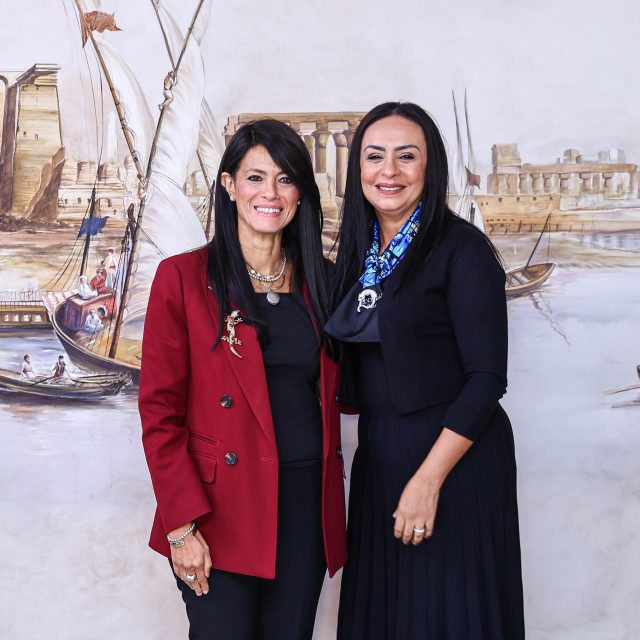
H.E. Dr. Rania Al-Mashat, Minister of Planning, Economic Development, and International Cooperation, received H.E. Dr. Maya Morsy, Minister of Social Solidarity, to discuss the Ministry of Social Solidarity’s investment plan for FY 2025/2026, as well as developments in launching Egypt’s Narrative for Economic Development: Reforms for Growth, Jobs & Resilience. The narrative serves as a comprehensive framework aligning the Government’s Program with Egypt’s Vision 2030.

Dr. Al-Mashat affirmed that the state attaches great importance to providing social protection and care programs for the most vulnerable groups. These programs, she explained, contribute to strengthening human capital through economic and social empowerment, which in turn increases productivity, enhances labor market participation, stimulates economic growth, and ensures sustainable development that benefits all citizens.

The meeting reviewed the Ministry of Social Solidarity’s approved investments for FY 2025/2026, which amount to approximately EGP 768.5 million, compared to EGP 455 million in FY 2024/2025, reflecting a growth rate of 75.5%.

The Minister outlined the plan’s priorities for FY 2025/2026, including: providing investments for projects nearing completion; prioritizing continuation projects, especially those with over 70% implementation; financing new priority projects in line with Presidential directives; advancing urgent initiatives and Phase II of the Decent Life program; and aligning investments with the State Ownership Policy Document.

The two ministers also reviewed financing gaps that need to be addressed, stressing the importance of integration and coordination between national and sectoral strategies. They emphasized the role of social protection and care in advancing sustainable development across its three dimensions—economic, social, and environmental.

In this context, Al-Mashat added that the Ministry of Planning, Economic Development and International Cooperation will, in the coming period, begin preparations for a new Economic and Social Development Plan. The plan will be framed within a Medium-Term Budget (2026/2027 – 2029/2030), covering the budget year and the three subsequent years, in order to unify the planning horizon. She also referred to the ‘Adaa’ system, which the Ministry is implementing to enhance the efficiency and effectiveness of the investment plan through the monitoring and evaluation of all administrative units, based on quantitative performance indicators.

She further referred to the launch of Egypt’s Narrative for Economic Development: Reforms for Growth, Jobs & Resilience, in line with directives from H.E. President Abdel Fattah El-Sisi and pursuant to State Planning Law No. 18 of 2022 and the Unified Public Finance Law No. 6 of 2022. These laws task the Ministry of Planning with developing an integrated planning system, setting national strategies, and linking them to macroeconomic policies at the national, regional, and sectoral levels.

The Minister added that the Narrative has been opened for public dialogue over the coming two months to incorporate feedback and recommendations. The outputs of the World Conference on Population, Health, and Human Development will also be integrated, reflecting the state’s prioritization of investment in human capital. The Ministry of Social Solidarity’s strategy will likewise be incorporated, highlighting government efforts in social protection and support for low-income groups.

For her part, H.E. Dr. Maya Morsy praised the Ministry of Planning’s leadership in launching the National Narrative and underscored the importance of cooperation between the two ministries in implementing social protection programs for vulnerable families.

Dr. Morsy stressed that the new strategic financial framework for economic empowerment reflects Egypt’s shift from traditional social protection to sustainable, inclusive models. This framework will unify national efforts and strengthen coordination among entities delivering financial inclusion and empowerment services. It will serve as an executive arm for economic empowerment packages, supporting Takaful and Karama families, and integrating capable beneficiaries into productive economic activities. Beneficiaries will gain access to financial products, including credit, insurance, savings, digital investment, and employment opportunities, alongside non-financial services, enabling families to graduate from the Takaful and Karama conditional cash transfer program.

She also highlighted the role of the Rural and Environmental Industries Support Fund, which the ministry seeks to transform into an integrated national platform linking financing with production and marketing. This platform will leverage rural comparative advantages, address market and service gaps, and implement innovative interventions that generate sustainable income for target families.

Dr. Morsy noted that the recently enacted Social Security Law No. 12 of 2025 strengthens social justice by institutionalizing financial support and establishing the Takaful and Karama Fund with clear financing sources. The law transforms Takaful and Karama into a legal entitlement rather than just a government program, building a stronger, more flexible safety net capable of addressing economic and social challenges while reinforcing long-term social stability.

She emphasized the central role of the Ministry of Social Solidarity in supporting Egyptian women, describing them as the cornerstone of family and society. Services dedicated to women include cash assistance, economic empowerment, healthcare, education, caregiving, rehabilitation, and counseling.

The Minister also discussed coordination efforts to support irregular workers, especially from vulnerable families. She stressed that digital transformation has been a priority, with the ministry building an advanced, integrated system that consolidates data on vulnerable families and individuals nationwide. This system, she said, enhances the inclusiveness of services for all family members through closer coordination with partner ministries and entities.

Dr. Morsy concluded by stressing that the ministry is committed to regular monitoring, evaluation, and updating of program and performance indicators, in line with the Government of Egypt’s Action Program.

Abu Dhabi –India Business Forum to deepen trade and investment ties

Abu Dhabi –India Business Forum to deepen trade and investment ties

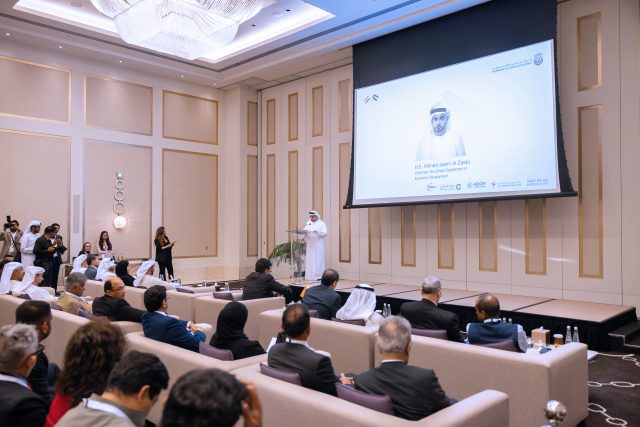
The Abu Dhabi–India business forum, co-organised by the Abu Dhabi Department of Economic Development (ADDED) and the Abu Dhabi Chamber of Commerce and Industry (ADCCI) in cooperation with the Federation of Indian Chambers of Commerce and Industry (FICCI) underscored the scale and momentum of the partnership and discussed ways to deepen trade and investment ties.

The forum, attended by His Excellency Piyush Goyal, India’s Minister of Commerce and Industry, H.E. Ahmed Jasim Al Zaabi, Chairman of ADDED, H.E. Hamad Sayah Al Mazrouei, Undersecretary of ADDED, and senior government and private-sector leaders, is building on the Comprehensive Economic Partnership Agreement’s (CEPA) achievements to further enhance relations in various sectors.

H.E. Ahmed Jasim Al Zaabi, Chairman of ADDED, said: “We are pleased to welcome Mr. Piyush Goyal, Honourable Minister of Commerce and Industry of the Republic of India, and the high-level delegation to open a new page in our deeply rooted partnership. Abu Dhabi is a trusted, future-ready partner for India’s growth story, with our ‘Falcon Economy’ creating ample opportunities in high-growth clusters including food, Agrictech, financial services, advanced manufacturing, digital infrastructure, smart transport, sustainable energy, and healthcare”.

H.E. Al Zaabi added: “Today, India is one of our largest trading partners. Since signing CEPA in 2022, Abu Dhabi’s non-oil trade with India is growing from strength to strength. In 2023, it rose by 13.7% and soared 94% in 2024. We are building on a legacy of collaboration to shape a future of shared prosperity, and there is enormous scope to deepen our trade, expand mutual investments, and co-create the industries of the future”. 

The Abu Dhabi–India business forum served as suitable platform to match opportunity with capability. India’s push to scale electronics, automotive and EVs, batteries, and pharmaceuticals dovetails with Abu Dhabi’s industrial strategy, while India’s quarter-trillion-dollar tech and business-services industry and the Global Capability Centres complement the emirate’s strengths. Emerging trade corridors are lowering frictions and shortening time-to-market for firms on both sides.

The programme featured presentations by the Abu Dhabi Investment Office (ADIO), Invest India, and companies from Abu Dhabi and India. Discussions focused on converting opportunities into projects with a view to onboard SMEs into supply chain. Participants agreed to maintain a structured follow-up cadence after the forum to turn commercial interest into deal flow and job creation.

Backed by (CEPA), bilateral trade between the UAE and India is fast approaching the USD 100 billion target set for 2030.  In 2024, UAE’s non-oil trade with India grew by 20.5% to exceed AED240 billion (USD 65.4 bn) in 2024, compared to AED199.3 billion (USD 54.3 bn) in 2023. In H1-2025, the strong growth continues with non-oil trade rising 33.9% to AED 138 billion (USD37.6 billion).

UAE’s investments in India reached over AED84.4 billion (USD23 billion) in 2024, making the UAE India’s seventh-largest global investor.

With Abu Dhabi’s globally connected infrastructure, pro-investment ecosystem, and strategic roadmaps, and India’s market scale, reform momentum and technological reach, the forum showcased a corridor where companies can innovate and invest with confidence.

Edaa and Kazakhstan Central Securities Depository Sign MoU to Strengthen International Market Connectivity

Edaa and Kazakhstan Central Securities Depository Sign MoU to Strengthen International Market Connectivity


The Securities Depository Center Company (Edaa), a subsidiary of Saudi Tadawul Group (STG), announced today the signing of a Memorandum of Understanding (MoU) with the Central Securities Depository of the Republic of Kazakhstan (KCSD).

The MoU establishes a framework for joint cooperation that spans depository services and corporate actions; the exchange of information on market developments; sharing best practices and business models of mutual benefit; exploring a potential bilateral linkage with KCSD to enhance market connectivity; forming joint working groups for specific projects; and organizing knowledge-sharing initiatives. The agreement underscores both parties’ commitment to advancing post-trade infrastructure and deepening cross-border capital-market connectivity.

This MoU also showcases Edaa’s growing portfolio of international partnerships and underscores its role in advancing Saudi Arabia’s position as a globally connected capital market, and in line with the aspirations of Vision 2030.

Ms. Hanan Alshehri, CEO of Edaa, said: “This memorandum of understanding marks another important milestone in Edaa’s journey to strengthen cross-border cooperation and expand the Kingdom’s financial market infrastructure. Through this MoU with KCSD, we are creating new opportunities to align global best practices, facilitate knowledge transfer, and ultimately enable greater connectivity for investors and issuers across our markets.”

Mr. Yedil Medeu, Chairman of KCSD, said: “Kazakhstan CSD sees significant strategic potential in the MENA region, especially in Saudi Arabia capital markets. We are working to establish reliable cooperation channels with its infrastructure, aiming to provide Central Asian investors with broader access to investment opportunities, ensure secure capital flows, and foster liquidity, diversification, and deeper financial integration.”

The collaboration between Edaa and KCSD builds on each organization’s commitment to innovation, resilience, and international engagement, paving the way for stronger financial ties between Saudi Arabia and Kazakhstan.

EBRD publishes first forecast for sub-Saharan Africa

EBRD publishes first forecast for sub-Saharan Africa

The European Bank for Reconstruction and Development (EBRD) expects growth in its new sub-Saharan Africa (SSA) region to average a robust 4.7 per cent in 2025 and 4.6 per cent in 2026.

The economic forecasts were published today in the Bank’s Regional Economic Prospects report.

Including SSA and Iraq, the Bank forecasts 3.2 per cent growth in its regions in 2025 and 3.3 per cent growth in 2026. Economies in the EBRD regions remain under pressure from continued global geopolitical tensions, increased export competition from China and limited fiscal room for manoeuvre.

For Benin, the Bank forecasts growth of 6.6 per cent in 2025 and 6.3 per cent in 2026. It expects Côte d’Ivoire to grow 6.3 per cent in 2025, edging up slightly to 6.4 per cent in 2026. It sees Ghana’s gross domestic product (GDP) growth at 4.3 per cent in 2025 and 4.8 per cent in 2026, while for Kenya, it forecasts 4.7 per cent growth in 2025 and 4.9 per cent growth in 2026. The Bank forecasts Nigeria’s GDP growth at 3.4 per cent in 2025 and 3.3 per cent in 2026. For Senegal, it sees 8.4 per cent growth in 2025 before a moderation to 4.1 per cent in 2026.

At the Bank’s 2023 Annual Meeting in Samarkand, the Board of Governors approved an amendment to Article 1 of the Agreement Establishing the EBRD, enabling it to operate in sub-Saharan Africa and Iraq. The shareholder acceptance threshold required for the amendment to take effect was reached in April and the amended Article 1 has now entered into force.

Benin, Côte d’Ivoire, Kenya, Nigeria and Senegal became the EBRD’s newest shareholders and investee economies in 2025.

The EBRD delivered a record €16.6 billion in investments across its economies in 2024, with annual disbursements hitting a record €10.6 billion. The Bank’s portfolio totalled €61.9 billion in 2024.

FII Institute Unveils Powerhouse Speaker Lineup for FII9 in Riyadh 

FII Institute Unveils Powerhouse Speaker Lineup for FII9 in Riyadh 

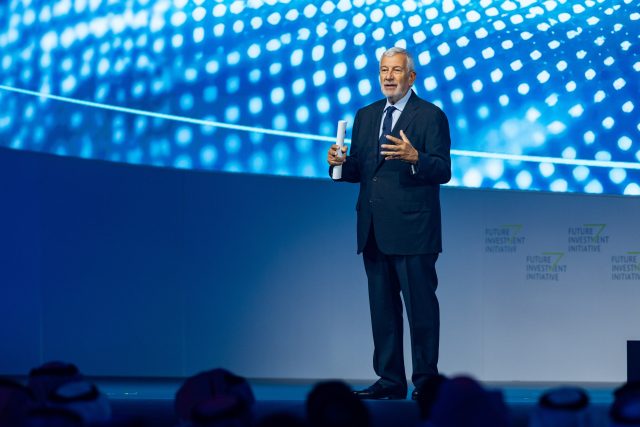
The Future Investment Initiative (FII) Institute today announced the speaker lineup and program for its flagship FII9 Conference, taking place October 27–30, 2025, at the King Abdulaziz International Conference Center (KAICC) in Riyadh. Under the theme “The Key to Prosperity: Unlocking New Frontiers of Growth,” FII9 will bring together more than 15 heads of state, alongside world leaders, global change makers, and visionary investors to confront the paradoxes shaping our future—balancing progress with consequences, innovation with constraints, and fragmentation with connectivity.

With 600+ speakers across 230+ sessions, FII9 will reaffirm its role as a global engine for investment, ideas, and impact. The conference opens with H.E. Yasir Al-Rumayyan, Governor of the Public Investment Fund (PIF) and Chairman of the Board of Trustees of FII Institute, presenting the 4th Priority Compass. This landmark survey gathers insights from tens of thousands of people across 32 countries—covering 66% of the world’s population— to guide leaders toward concrete, citizen-driven solutions.

FII Institute and Richard Attias hosts breakfast press conference at Coco’s, 9/19/2025. Photo by Chris Lee

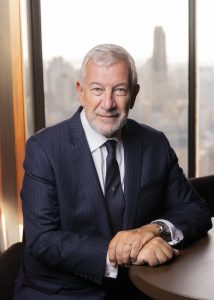
Richard Attias, Chairman of the Executive Committee and Acting CEO of FII Institute, emphasized: “FII9 is where global leaders align capital with purpose. The Priority Compass ensures our discussions are not abstract, but rooted in the real concerns of people across the world.”

Two plenary halls will stage high-level debates, fireside chats, and Board of Changemakers sessions on humanity’s most urgent questions:

Can shared economic interests bridge divides or deepen fractures?

How should trade rules evolve to protect security while preserving global coherence?

What pathways can deliver energy that is secure, sustainable, and affordable?

How can innovation accelerate responsibly without creating new global imbalances?

Confirmed speakers include:

H.E. Khalid bin Abdulaziz Al-Falih, Minister of Investment, Ministry of Investment of Saudi Arabia (MISA)

Amin Nasser, President & CEO, Aramco

Bill Ackman, Founder & CEO, Pershing Square Capital Management

Bruce Flatt, CEO, Brookfield

David M. Rubenstein, Co-Founder & Co-Chairman, The Carlyle Group

Dina DiLorenzo, President, Guggenheim Investments

Jamie Dimon, Chairman & CEO, JPMorgan Chase

Jane Fraser, CEO, Citi

Laurence Fink, Chairman & CEO, BlackRock

Patrick Pouyanné, Chair & CEO, TotalEnergies

Ray Dalio, Founder & CIO Mentor, Bridgewater Associates

Ron O’Hanley, Chairman & CEO, State Street Corporation

Ruth Porat, President & CIO, Alphabet & Google

Through Interactive Labs and exclusive Conclaves, leaders and executives will shape strategies that influence investment flows, global policies, and societal outcomes.

FII9, a members-only summit, will convene thousands of delegates and international media for four days of decision-shaping dialogue and opportunities, reinforcing Riyadh’s role as a hub for global collaboration.

For the full program, visit: https://fii-institute.org/conference/fii9-edition

Abu Dhabi Chamber signs agreement with Sino-International Entrepreneurs Federation to boost trade and investments

Abu Dhabi Chamber signs agreement with Sino-International Entrepreneurs Federation to boost trade and investments

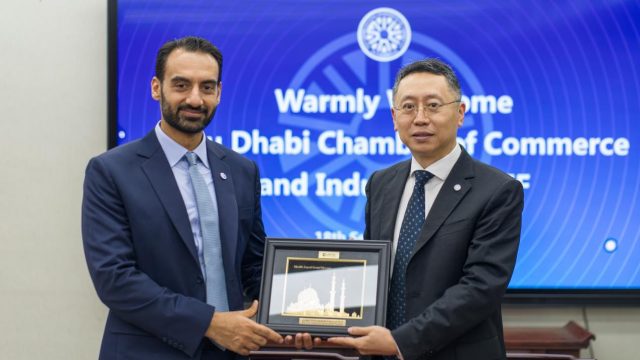
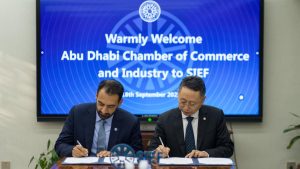
The Abu Dhabi Chamber of Commerce and Industry signed a cooperation agreement with the Sino-International Entrepreneurs Federation (SIEF) during an official visit to Beijing, organised by the Ministry of Economy and Tourism. The agreement aims to strengthen economic and trade partnerships between the business communities in the two countries and strengthen Abu Dhabi’s position as a global economic hub.

Abu Dhabi Chamber, Sino-International Entrepreneurs Federation, Ministry of Economy and Tourism, Ali Mohammed Al Marzooqi, Tony Dong, Investopia Global, China, UAE, Beijing, Hong Kong, Investment, Trade, Economic Partnerships, Economic Diversification, Private Sector, International Relations, Cooperation Agreements, Economic Forums, Trade Delegations, Biotechnology, Semiconductors, Energy, Smart Vehicles, Global Economy

The agreement was signed on behalf of Abu Dhabi Chamber by His Excellency Ali Mohamad Al Marzooqi, Director General of Abu Dhabi Chamber, and on behalf of the Sino-International Entrepreneurs Federation Mr. Tony Dong, Chief Representative in China of (SIEF).

The agreement emphasises facilitating the exchange of economic, trade, and investment expertise and information, along with establishing effective communication channels that support the private sector’s ambitions and open broader opportunities for mutual growth. The Abu Dhabi Chamber’s delegation participated in Investopia Global, held in Hong Kong (SAR) and Beijing on 17 and 19 September 2025. These gatherings served as a key strategic platform, enhancing the global presence of the UAE business community and reinforcing Abu Dhabi’s position as a vital international economic partner.

The agreement covers the exchange of information related to the economy, trade, and investment, as well as the sharing of insights into the laws and policies governing trade and investment. It also calls for creating investment opportunities for the private sector, organising joint virtual events, facilitating participation in exhibitions, forums, and conferences, supporting visits of trade and economic delegations, and exchanging technical knowledge and training between institutions.

Economic relations between the UAE and China are expanding rapidly, with bilateral non-oil trade increasing by 3%, reaching AED 327.5 billion (US$ 89.2 billion) last year, driven by an 8% increase in UAE imports to AED 308.7 billion (US$ 84 billion). Many of these imports are re-exported, strengthening the UAE’ role as a major gateway for Chinese products into markets in the MENA and Africa.

According to the International Trade Centre, there is potential for further growth in UAE exports to China across diverse sectors, including precious metals, aluminum, copper, paper products, cosmetics, and processed foods. Abu Dhabi Chamber’s Chinese members rose by 69.4% in 2024. At the same time, Emirati investments in China continue to grow across a wide range of sectors, including manufacturing, construction, logistics, telecommunications, agriculture, property, energy, and trade.

His Excellency Ali Mohammed Al Marzooqi, Director-General of the Abu Dhabi Chamber of Commerce and Industry, said: “This agreement marks a milestone in the strategic cooperation between Abu Dhabi and China. It reflects Abu Dhabi Chamber’s commitment to establishing strong international partnerships that support the private sector and widen opportunities for growth and expansion. It enhances communication channels and facilitates the exchange of economic expertise and knowledge, driving innovative investment opportunities and boosting the competitiveness of businesses on both sides. By doing so, it aligns with Abu Dhabi’s vision to become a global leader in business and investment”.

Mr. Tony Dong, Chief Representative in China of the Sino-International Entrepreneurs Federation (SIEF), said: “SIEF is proud to announce a long-term strategic partnership with the Abu Dhabi Chamber of Commerce and Industry. For nearly two decades SIEF has acted as a trusted, neutral facilitator, connecting premier business leaders across industries, continents and cultures and converting dialogue into tangible deals for Chinese and global companies—an approach that mirrors the Chamber’s own vision.
He added “This partnership establishes an exclusive gateway for SIEF’s global members to connect with Abu Dhabi’s business community. Leveraging its extensive network—which includes Chinese government agencies, financial institutions, private enterprises, R&D centers, and legal-arbitration bodies—to deliver concrete support. Together we will pursue practical cooperation in bilateral match-making, landing services, executive training and more, turning Abu Dhabi’s and China’s complementary strengths into shared growth.”

This agreement demonstrates the Chamber’s commitment to expanding its global network and amplifying the presence of the UAE’s private sector in China, supporting strategies for economic diversification and future-focused cooperation in such areas as semiconductors, energy, biotechnology, life sciences, and autonomous vehicles. By facilitating regular exchanges of delegations and joint activities, it also supports the broader business climate, adding value to the UAE economy.