

Forbes Middle East has unveiled its annual Top 100 Travel and Tourism Leaders 2026 list, recognizing 100 leaders driving the region’s airlines, airports, hotels, destinations, and travel services across the public and private sectors. Their businesses and institutions are playing an expanding role in the Middle East’s economic diversification, investment, and destination development.
Leaders on this year‘s list represent nine countries across the region. The UAE leads with 56 entries, followed by Saudi Arabia with 18 and Egypt with eight.
Hotels and resorts dominate the sector breakdown, accounting for half of the ranking with 50 entries, followed by the public sector with 14, airlines with 11, and airports with seven.
Sheikh Ahmed bin Saeed Al Maktoum, chairman and chief executive of Emirates Airline & Group, retains the top spot for the fifth consecutive year. In FY2025-26, the group reported $41 billion in revenues and invested $4.9 billion in new aircraft, facilities, equipment, and the latest technologies to support its growth plans. Hamad Al Khater, group CEO of Qatar Airways, ranks second, followed by Ageel Alshaibani, CEO of the Saudi Tourism Authority (STA).
The ranking comes as the Middle East’s travel and tourism industry continues to expand its economic footprint. According to the World Travel & Tourism Council (WTTC), the sector grew by 5.3% in 2025, outpacing global growth of 4.1%. It contributed $385.8 billion to the region’s gross domestic product (GDP) and supported 7.1 million jobs, with international tourist arrivals approaching 100 million in 2025, 39% above 2019 levels, according to UN Tourism.
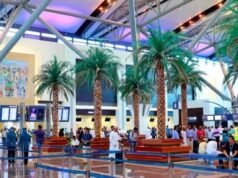
Several of the region’s largest tourism markets recorded significant visitor numbers in 2025. Travel and tourism contributed nearly $68.5 billion to the UAE economy, while Dubai welcomed 19.59 million international overnight visitors. Dubai International Airport (DXB) handled a record 95.2 million passengers. Saudi Arabia recorded more than $81 billion in domestic and inbound tourism spending from 123 million visitors, while Egypt welcomed a record 19 million tourists. Morocco recorded 19.8 million arrivals, with tourism revenues reaching $14.8 billion.
In 2026, however, the sector has faced a more challenging operating environment amid geopolitical tensions and disruptions to airspace and travel flows. WTTC forecasts a 14.5% decline in the region’s travel and tourism GDP to $330 billion. Passenger demand among Middle Eastern carriers fell 60.8% year on year in March and 46.6% in April, according to the International Air Transport Association (IATA), before the decline moderated to 9.5% by July.
Despite these pressures, investment in tourism infrastructure, aviation, hospitality, and destination development continues across the region. Miral and Disney are moving ahead with plans for the region’s first Disney theme park and resort on Yas Island in the UAE, alongside plans unveiled this year for new Warner Bros. World attractions based on the DC and Harry Potter franchises. Red Sea Global opened its second giga-destination, AMAALA, in July, while Diriyah Company signed a $728 million deal for the Waldorf Astoria Superblock during the same month.
To compile the Top 100 Travel and Tourism Leaders 2026, Forbes Middle East evaluated leaders based in the MENA region across key sectors, including airlines, airports, private aviation, hospitality, destinations and experiences, and the public sector. The ranking considered business scale, including relevant indicators such as hotels and keys, passengers, visitors, fleet sizes, destinations, revenues, assets, investments, regional presence, and employees. It also assessed operational and financial performance, leadership experience and tenure, ownership where applicable, and key strategic achievements during 2025–2026, including expansions, partnerships, investments, and major initiatives.