

In July 2024, amid ongoing conflict and widespread displacement in the Gaza Strip, variant poliovirus – with links to poliovirus found in Egypt – was detected in wastewater in Khan Younis and Deir al Balah for the first time in more than 25 years. Poliovirus was then confirmed in a 10-month-old child in Gaza who had never received any vaccines. Immunization had been on hold in Gaza since the conflict began.
This triggered an urgent public health response. Under the leadership of the Ministry of Health, and with support from WHO and partners, health workers mobilized to vaccinate hundreds of thousands of children against a disease that can cause lifelong paralysis.
Behind this complex operation were countless individuals working under extraordinary conditions, among them 4 women whose leadership, determination and commitment – despite conflict, insecurity and personal loss – helped ensure that children in Gaza received protection against polio.
In October 2023, during the first week of the conflict in the Gaza Strip, Dr Ola El Najjar lost 16 members of her family, including her parents, siblings and their children. Her home was bombed and belongings stolen and she was forced to flee with her husband and 4 young children.
In the face of devastating personal loss, she remained determined to protect children from polio – a preventable disease. When she heard about the polio outbreak Dr Ola was determined to take action, even though this meant leaving her own children at home amid the insecurity.
Destroyed roads and no power or internet were among the challenges she faced as she oversaw vaccination campaigns as a municipal supervisor actively involved in microplanning and coordination with partners. Dr Ola led vaccination activities in Gaza City. Even after the fragile ‘hours of peace’ set aside during the humanitarian pause for vaccination campaigns had ended, she and her colleagues stayed behind to collate data, knowing the journey home could be risky.
Reflecting on why the campaigns were effective, Dr Ola says the presence of women alongside men in the vaccination and social mobilization teams were among the reasons that helped ensure better outreach to mothers and children.
During the third round of the polio vaccination campaign in February 2025, Dr Yara Alhajahmed spent her days moving through Gaza City, monitoring vaccine carriers, tally sheets and mobile teams. In the evenings, she attended to essential logistics, including arranging additional supplies for the following day.
Amid the many challenges she faced one memory, of a 9-year-old boy living in a school that served as a shelter at night and a temporary vaccination centre during the day, stands out. It still brings a smile to her face.
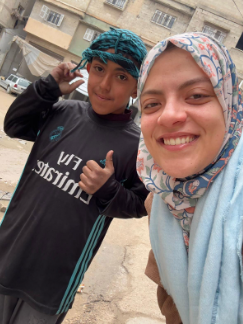
“He took it upon himself to knock on all the doors in his neighbourhood to ensure caregivers brought every child under 10 years of age for vaccination,” says Dr Yara.
At a time when survival often took priority over everything, Dr Yara witnessed vaccinators going beyond the call of duty. In one area where underserved Bedouin families were living, bordering another area that required special coordination for access, a female vaccinator worked closely with social mobilizers to ensure that every child received the vaccine, bringing hope to the children and families she served.
In addition to vaccination-related work, Dr Yara and her colleagues joined other partners to support the Health Ministry set up a unified surveillance system for 16 diseases and conditions across the Gaza Strip. Their ongoing work entails onboarding facilities, training staff, verifying alerts and analysing data to enable timely, evidence-based public health action. This helped strengthen health systems at a time when most efforts were focused on responding to immediate emergencies.
During the polio vaccination campaign, Dr Refqa Skaik worked across Deir al Balah (the Middle Area) and Khan Younis, coordinating teams, supplies and partners.
In the course of her work, she noticed the extraordinary commitment of both health workers and families. She watched as caregivers set aside their fears to protect their children from a preventable, paralysing disease, and how they continued to trust health workers when nothing else felt safe.
Reflecting on women’s roles in the response, Dr Refqa noted that young female doctors sometimes had to work harder to build trust with families and demonstrate their expertise, using careful explanations and evidence-based discussions.
Despite everything the children had witnessed, she also observed moments of joy during the vaccination efforts — a child proudly showing a little finger marked with purple ink after vaccination, a cameraman sharing a kind word. For Dr Refqa, these small moments revealed children’s ability to find joy in the harshest conditions.
“Parents couldn’t protect their children from airstrikes or hunger,” she reflects. “But they believed they could protect them from polio, and they did.”
During the 3 campaigns rolled out as part of the polio outbreak response in Gaza, Dr Mona Farid Abu Omar took on 2 roles, as field supervisor in the Middle Area and manager of vaccines and logistics in Al-Qarara and Abasan Al-Kabira Primary Health Centre.
Of the 2 roles, she preferred managing vaccines and logistics, which required strong leadership: to guide teams, ensure the availability of supplies, coordinate activities, prepare reports and maintain accountability. It was a role that placed her at the centre of both health worker teams and the communities they served.
Working close to areas that needed special coordination for access, mornings often began with quiet but palpable tension as she prepared for the day ahead. Yet whatever challenges she faced, she remained determined that no delay would prevent a child from receiving protection.
“Our mission was stronger than fear,” she said. “There were moments of concern, but we remained focused, following safety protocols and supporting one another as a team. Being part of the response strengthened my resilience and reaffirmed my belief that women can lead and serve courageously, even in the most difficult contexts.”